Vertex AI Gemini generateContent (non-streaming) API

Introduction

In my recent blog post, I’ve been exploring Vertex AI’s Gemini REST API and mainly talked about the streamGenerateContent method which is a streaming API.

Recently, a new method appeared in Vertex AI docs: generateContent which is the non-streaming (unary) version of the API.

In this short blog post, I take a closer look at the new non-streaming generateContent API and explain why it makes sense to use as a simpler API when the latency is not super critical.

Read More →

Using Vertex AI Gemini from GAPIC libraries (C#)

Gemini
Gemini

Introduction

In my previous Using Vertex AI Gemini REST API post, I showed how to use the Gemini REST API from languages without SDK support yet such as C# and Rust.

There’s actually another way to use Gemini from languages without SDK support: GAPIC libraries. In this post, I show you how to use Vertex AI Gemini from GAPIC libraries, using C# as an example.

What is GAPIC?

At this point, you might be wondering: What’s GAPIC? GAPIC stands for Google API CodeGen. In Google Cloud, all services have auto-generated libraries from Google’s service proto files. Since these libraries are auto-generated, they’re not the easiest and most intuitive way of calling a service. Because of that, some services also have hand-written SDKs/libraries on top of GAPIC libraries.

Read More →

Using Vertex AI Gemini REST API (C# and Rust)

Introduction

Back in December, Google announced Gemini, its most capable and general model so far available from Google AI Studio and Google Cloud Vertex AI.

Gemini
Gemini

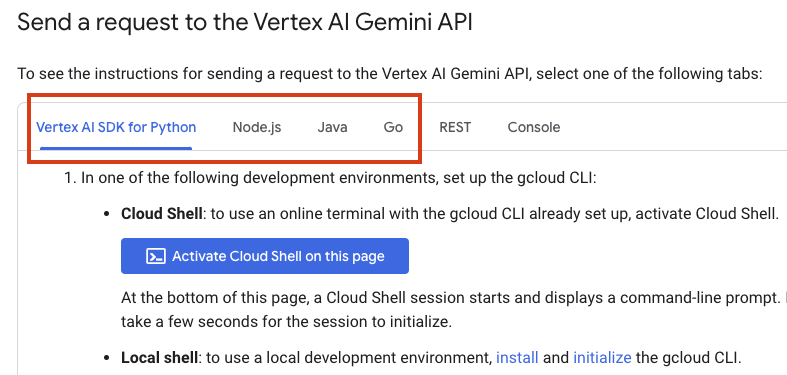
The Try the Vertex AI Gemini API documentation page shows instructions on how to use the Gemini API from Python, Node.js, Java, and Go.

alt_text
alt_text

That’s great but what about other languages?

Even though there are no official SDKs/libraries for other languages yet, you can use the Gemini REST API to access the same functionality with a little bit more work on your part.

Read More →

Test and change an existing web app with Duet AI

Duet AI
Duet AI

In the Create and deploy a new web app to Cloud Run with Duet AI post, I created a simple web application and deployed to Cloud Run using Duet AI’s help. Duet AI has been great to get a new and simple app up and running. But does it help for existing apps? Let’s figure it out.

In this blog post, I take an existing web app, explore it, test it, add a unit test, add new functionality, and add more unit tests all with the help of Duet AI. Again, I captured some lessons learned along the way to get the most out of Duet AI.

Read More →

Create and deploy a new web app to Cloud Run with Duet AI

Duet AI
Duet AI

I’ve been playing with Duet AI, Google’s AI-powered collaborator, recently to see how useful it can be for my development workflow. I’m pleasantly surprised how helpful Duet AI can be when provided with specific questions with the right context.

In this blog post, I document my journey of creating and deploying a new web application to Cloud Run with Duet AI’s help. I also capture some lessons learned along the way to get the most out of Duet AI.

Read More →

Multi-language libraries and samples for GenAI in Vertex AI

You might think that you need to know Python to be able to use GenAI with VertexAI. While Python is the dominant language in GenAI (and Vertex AI is no exception in that regard), you can actually use GenAI in Vertex AI from other languages such as Java, C#, Node.js, Go, and more.

Let’s take a look at the details.

Vertex AI SDK for Python

The official SDK for Vertex AI is Vertex AI SDK for Python and as expected, it’s in Python. You can initialize Vertex AI SDK with some parameters and utilize GenAI models with a few lines of code:

Read More →

Generative AI Short Courses by DeepLearning.AI

Introduction

In my previous couple posts (post1, post2), I shared my detailed notes on Generative AI Learning Path in Google Cloud’s Skills Boost. It’s a great collection of courses to get started in GenAI, especially on the theory underpinning GenAI.

Since then, I discovered another great resource to learn more about GenAI: Learn Generative AI Short Courses by DeepLearning.AI from Andrew Ng.

In this post, I summarize what each course teaches you to help you decide which course to take. I highly recommend taking all 4 courses. They’re full of useful information and short enough that even if you’re not fully interested in the topic, you can still get a good idea about it in a short amount of time.

Read More →
GenAI  AI 

Generative AI Learning Path Notes – Part 2

If you’re looking to upskill in Generative AI, there’s a Generative AI Learning Path in Google Cloud Skills Boost. It currently consists of 10 courses and provides a good foundation on the theory behind Generative AI.

As I went through these courses myself, I took notes, as I learn best when I write things down. In part 1 of the blog series, I shared my notes for courses 1 to 6. In this part 2 of the blog series, I continue sharing my notes for courses 7 to 10.

Read More →

Generative AI Learning Path Notes – Part 1

If you’re looking to upskill in Generative AI (GenAI), there’s a Generative AI Learning Path in Google Cloud Skills Boost. It currently consists of 10 courses and provides a good foundation on the theory behind Generative AI and what tools and services Google provides in GenAI. The best part is that it’s completely free!

GenAI Learning Path
GenAI Learning Path

As I went through these courses myself, I took notes, as I learn best when I write things down. In this part 1 of the blog series, I want to share my notes for courses 1 to 6, in case you want to quickly read summaries of these courses.

Read More →