A2UI Express and Swappable Inference Formats

A2UI Express and Swappable Inference Formats

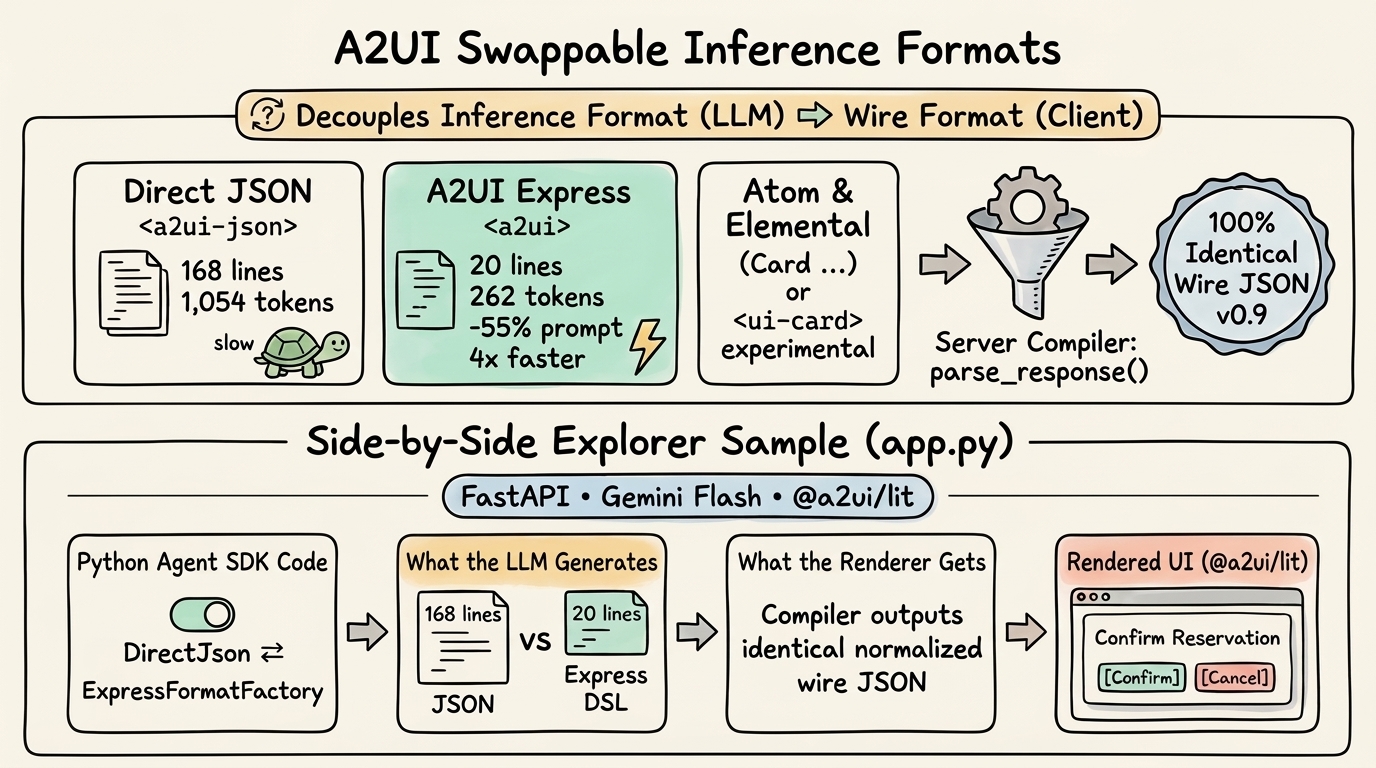
In my Agent Protocols - MCP, A2A, A2UI, AG-UI and Agent to UI Protocol (A2UI) with Agent Development Kit (ADK) posts, I introduced A2UI —Google’s declarative generative UI protocol that lets AI agents return rich, interactive user interfaces across web, mobile, and desktop using JSON messages (createSurface, updateComponents, updateDataModel, and deleteSurface).

While standard JSON is an ideal wire protocol for client renderers (Lit, Angular, React, Flutter), having an LLM generate deeply nested wire JSON token-by-token is verbose, token-heavy, and adds latency. Recently, the A2UI team introduced Swappable Inference Formats and made A2UI Express the new default format in the A2UI Agent SDKs—cutting output tokens by ~3x–4x, shrinking system prompts by more than half, and speeding up UI generation without requiring any changes to client renderers.

Read More →
Agentic Commerce Protocols - UCP and AP2

Agent Protocols: MCP, A2A, UCP, AP2, A2UI, AG-UI

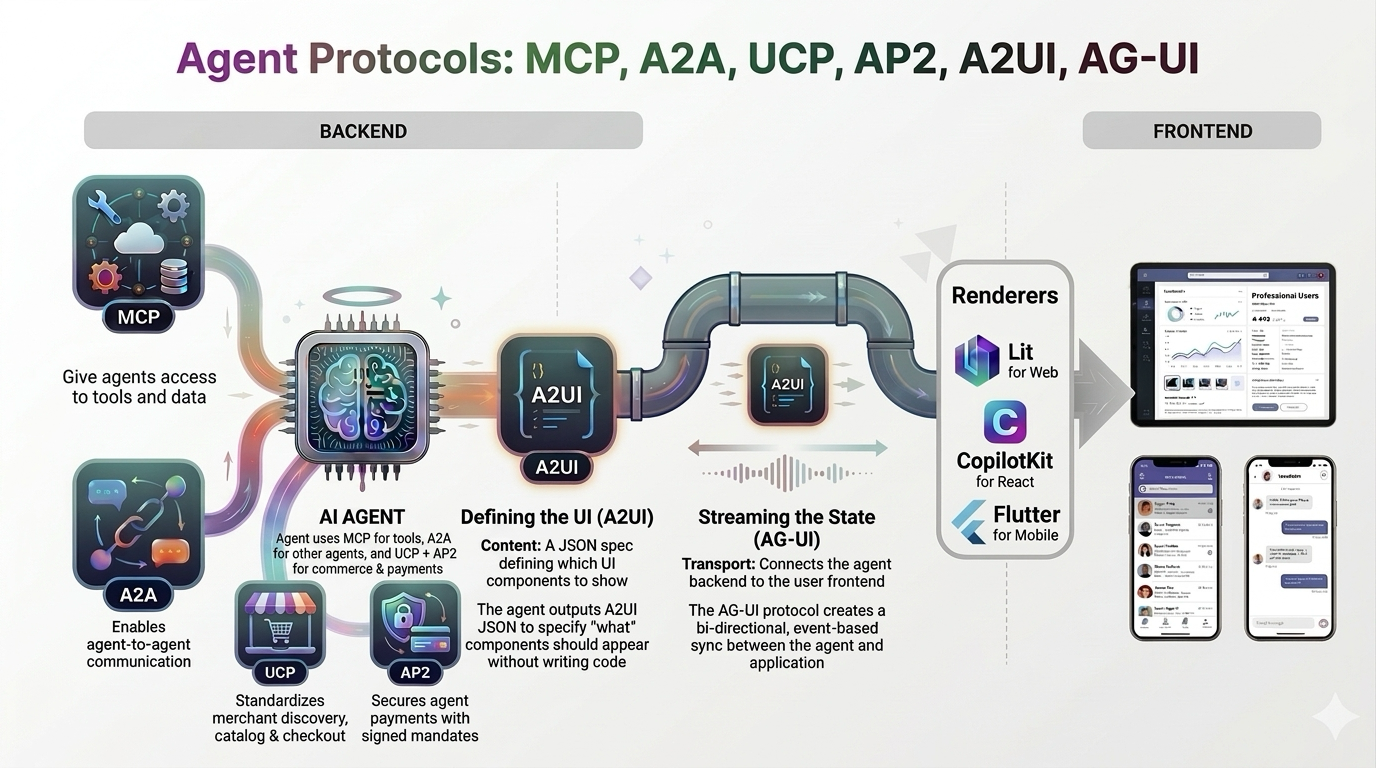
In my Agent Protocols - MCP, A2A, A2UI, AG-UI post back in March, I provided a high-level overview of the main agent protocols for tool use (MCP), agent-to-agent communication (A2A), and agent-to-UI interactions (AG-UI and A2UI).

Recently, I had a chance to explore two newer protocols focused on agentic commerce and payments: the Universal Commerce Protocol (UCP) and the Agent Payments Protocol (AP2) . Traditional e-commerce and payment flows assume a human is directly browsing a website and clicking “Buy” on a trusted checkout screen. When an AI agent shops and pays on your behalf, both the commerce workflow and the cryptographic proof of user authorization need a standard language.

Read More →
GenAI  Agents  UCP  AP2  ADK 

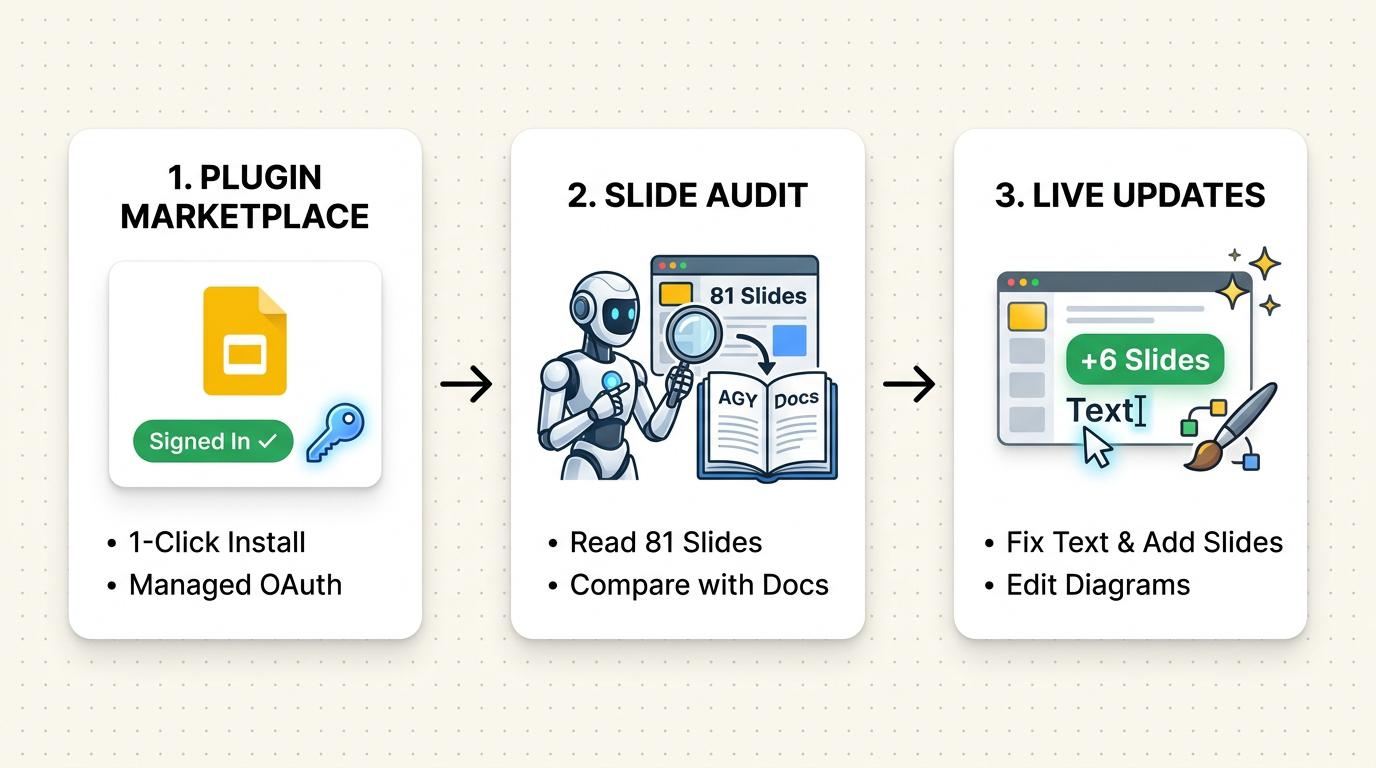
Antigravity Plugin Marketplace in Action: Auditing My Talk Slides with the Google Slides Plugin

Antigravity Plugin Marketplace in Action

Back in August, I wrote Where does Antigravity look for Plugins? to explain how plugins bundle skills, rules, subagents, hooks, MCP servers, and sidecars into a single unit. At the time, installing a plugin meant pointing Antigravity to a GitHub repository or a local directory path.

This week, the team launched the Antigravity Plugin Marketplace : a curated catalog of first-party Google plugins and third-party partner plugins built directly into the Antigravity UI and CLI.

Read More →

Testing and Serving A2A Agents from the Terminal with A2A CLI

A2A CLI demo
A2A CLI demo

In my Agent Protocols - MCP, A2A, A2UI, AG-UI post, I provided a high-level overview of the main agent protocols, including the Agent2Agent (A2A) Protocol . When building an A2A server, you need an easy way to test that its agent card is published properly and that it responds to messages as expected.

Traditionally, you either had to write a custom client script using the A2A SDK or clone and run the web-based A2A Inspector . Recently, the A2A project released the official A2A CLI (a2a) tool, which makes testing A2A agents as simple as running a single terminal command. Even better, it includes a built-in server mode to spin up test agents or wrap existing scripts as A2A servers.

Read More →

Setting Up an Antigravity Workspace for Multiple Conversations

Setting Up an Antigravity Workspace for Multiple Conversations

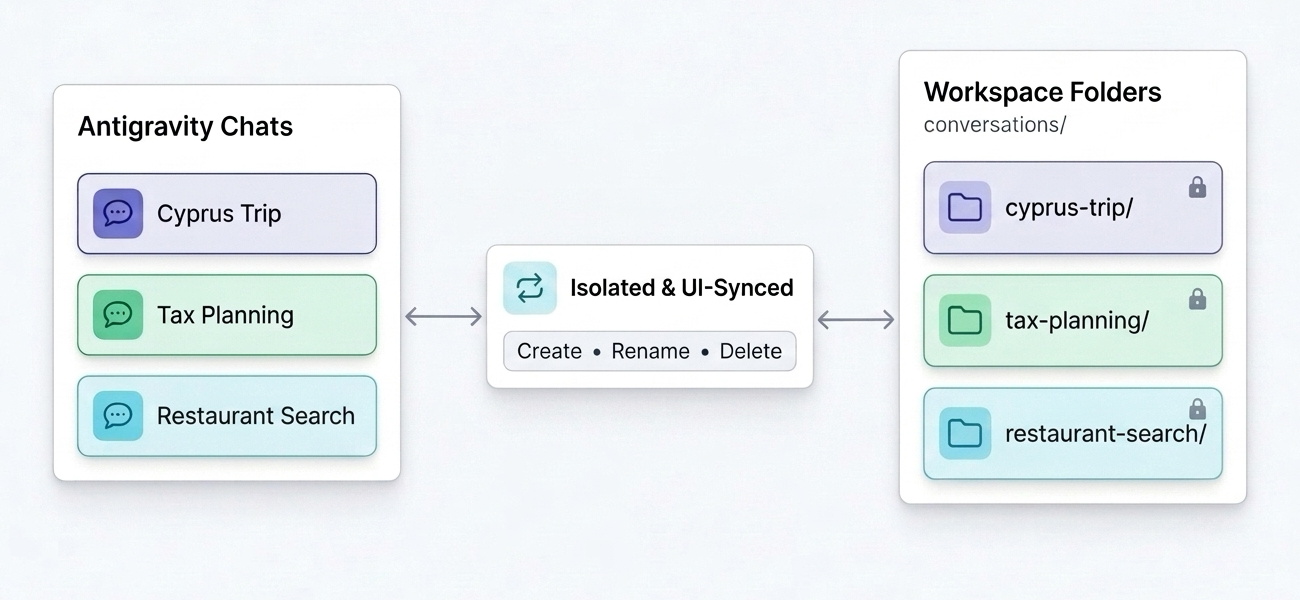
Beyond coding projects, I use Antigravity (AGY) all the time for personal tasks and random day-to-day questions—like trip planning, tax research, quick scripts, or brainstorming. Rather than creating a separate project folder for every little topic, I keep a single project called llm-conversations for all my miscellaneous chats and tasks.

However, using a single project for unrelated conversations comes with an annoying problem: context bleed and clutter. By default, every conversation shares the same root folder, so the agent sees files from unrelated chats, litters the root directory with random markdown files and scripts, and leaves behind orphaned files even after you delete a conversation in the UI.

Read More →

Scheduling Tasks in Antigravity

Scheduling Tasks in Antigravity

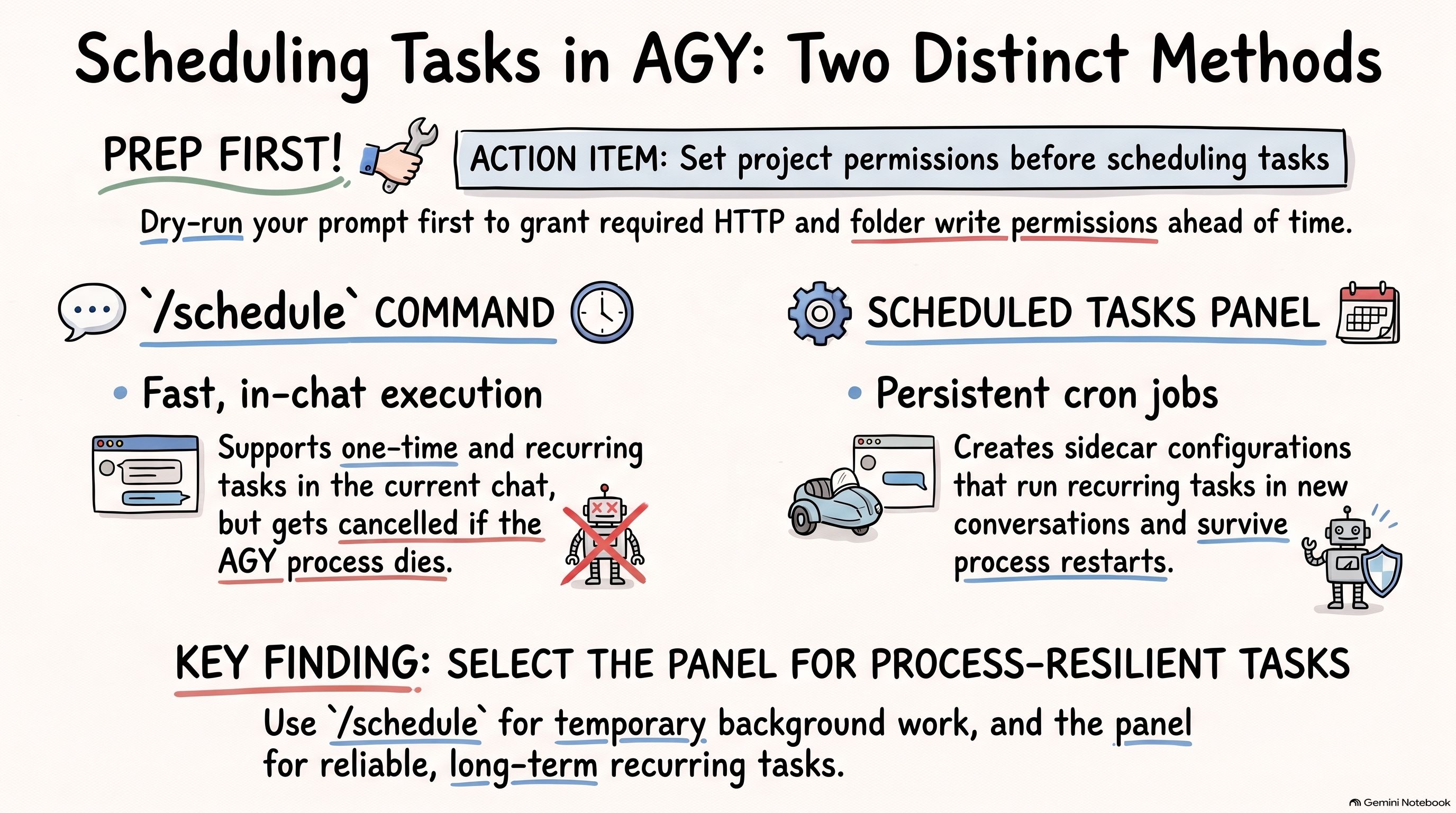
Antigravity (AGY) allows you to schedule instructions to run on a recurring schedule or one-time timer. However, it has two different ways of scheduling that results in two different behaviors.

In this post, I’ll share my learnings on scheduling tasks in AGY and the gotchas to look out for.

Two ways of scheduling tasks in AGY

In AGY, there are two ways of scheduling tasks:

Read More →

Agent Permissions in Antigravity

Agent Permissions in Antigravity

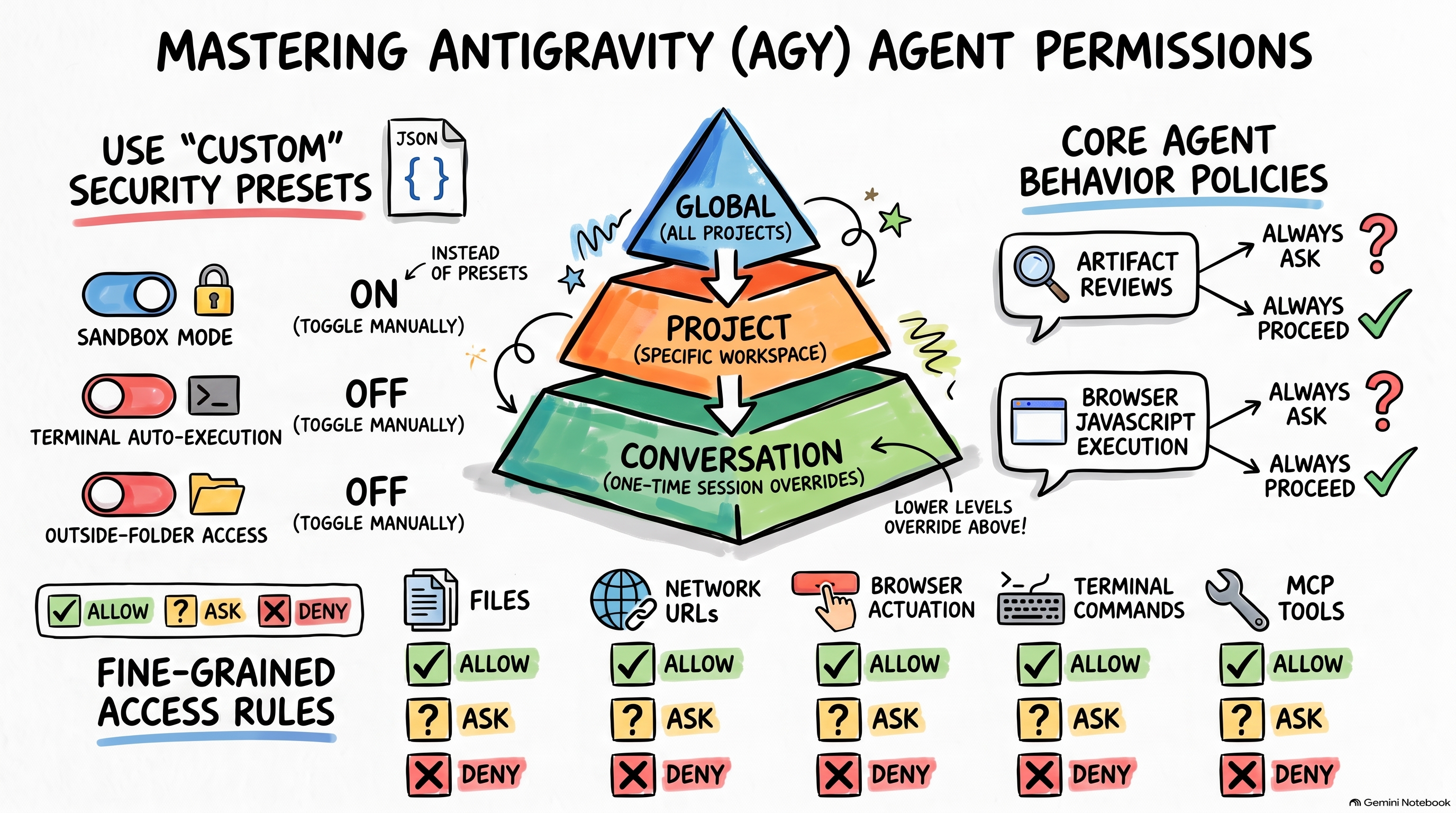
Antigravity (AGY) has an extensive permission system that defines how the agent should behave and what it has access to. However, these permissions are scattered across different settings and saved in various files that might make reasoning them difficult.

In this post, I’ll deep dive into these permission settings and share my learnings.

Permission Hierarchy

Before looking at the permission settings in detail, it’s important to note that the permissions in AGY are organized in a hierarchy:

Read More →

Summary : Where does Antigravity look for configurations?

Antigravity Configuration Summary

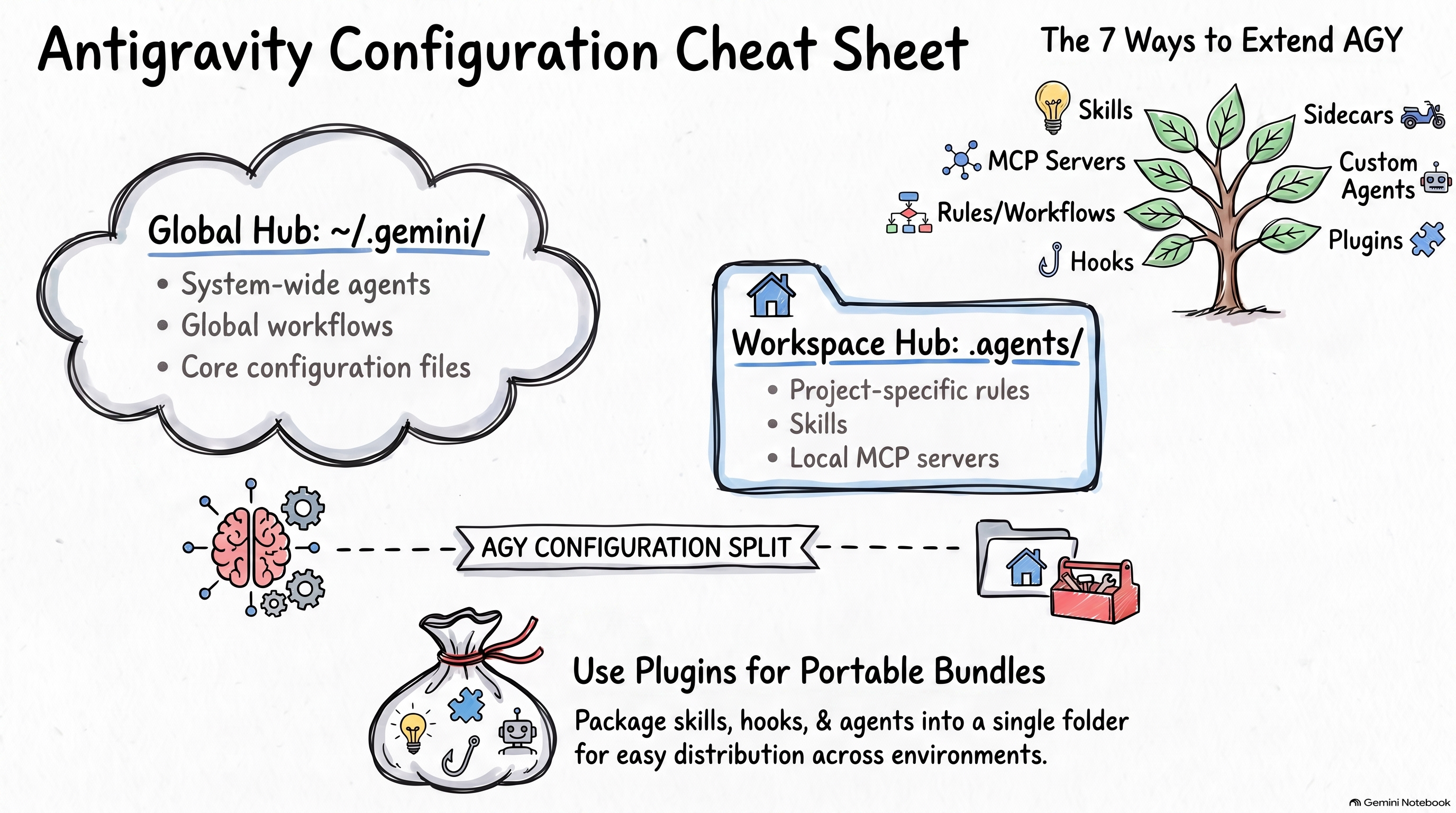
💡 This post is the concluding summary of a series on Antigravity configuration:

Over the past few weeks, I explored the ways to configure and extend Google Antigravity (AGY). What started as a simple exploration into agent skills quickly grew into a journey uncovering MCP servers, rules, workflows, lifecycle hooks, background sidecars, custom agents, and plugins.

Read More →

Where does Antigravity look for Agents?

Antigravity Agents
Antigravity Agents

ℹ️ Note

This post blog is part of a series, see Summary : Where does Antigravity look for configurations?

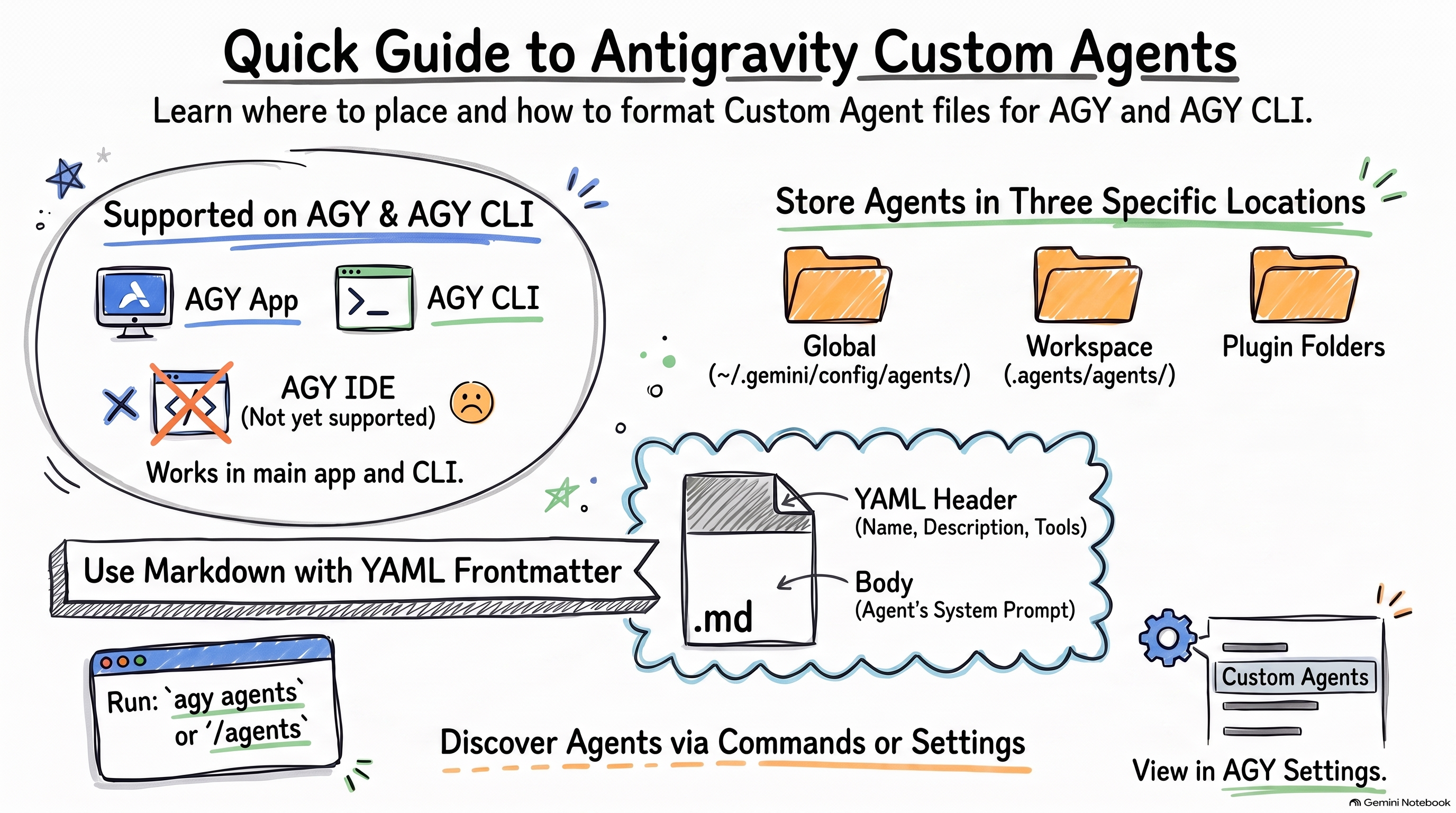
Custom Agents have been recently announced in Antigravity (AGY). In today’s post, I’ll explore how to configure and use Custom Agents.

Custom Agents

Custom Agents in AGY are a way to create customized agents that can be used as main or sub-agents. This can be useful to limit the agent to a particular role with its specialized instructions, tools, and constraints. Currently, custom agents are only supported in AGY and AGY CLI, but not in AGY IDE.

Read More →

Where does Antigravity look for Plugins?

Antigravity Plugins
Antigravity Plugins

ℹ️ Note

This post blog is part of a series, see Summary : Where does Antigravity look for configurations?

I’ve been exploring how to configure and extend Antigravity (AGY).

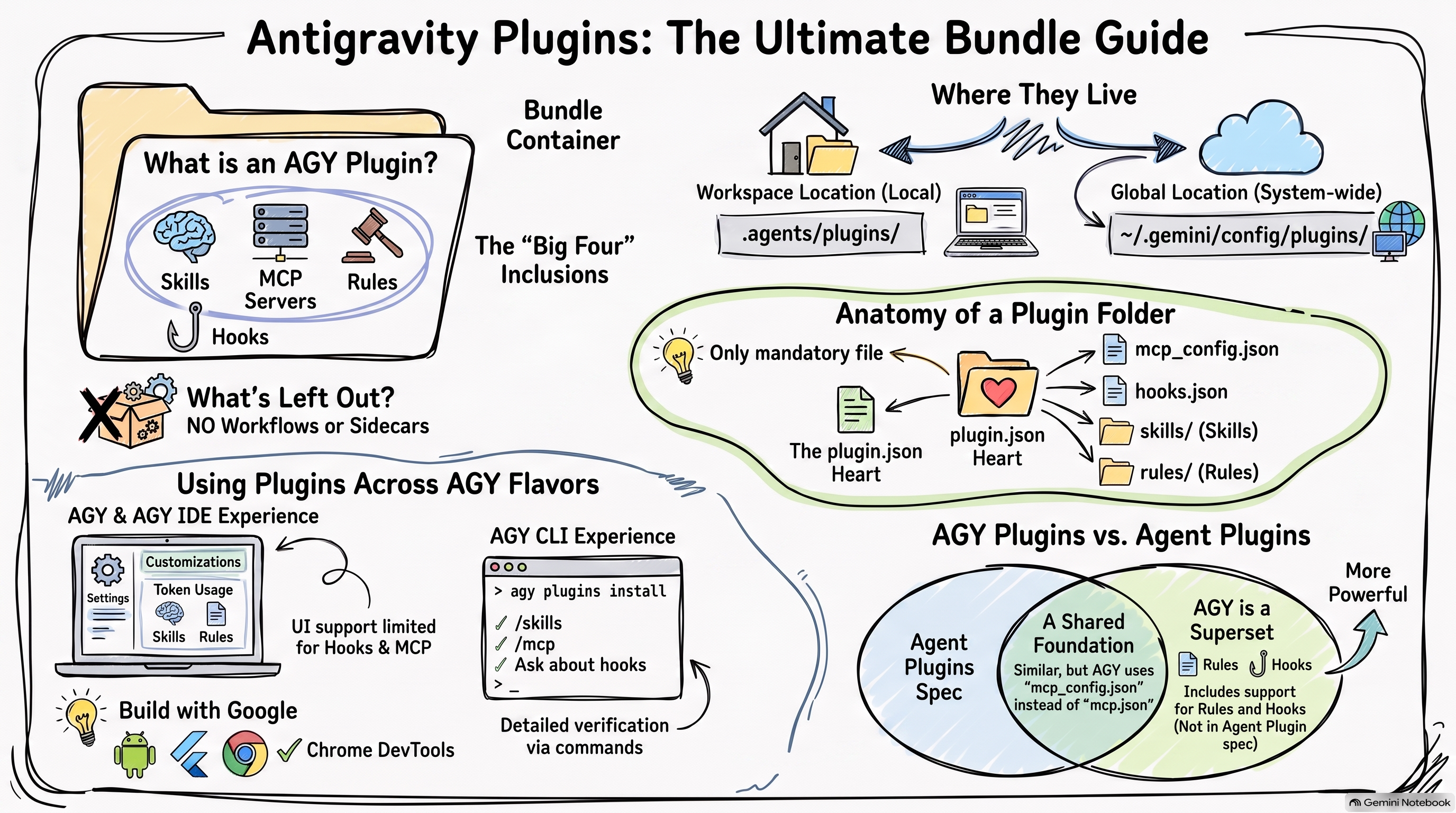
In today’s post, I’ll explore Plugins, yet another way of configuring AGY. We’ll also explore Build with Google plugins and the differences between AGY plugins and Agent plugins.

Plugins

Plugins in AGY are a way to package and group **Agents, Skills, MCP Servers, Rules, and Hooks together. This can be useful when you want to distribute and install a collection of these configuration options in one go. It’s also another way of configuring and extending AGY.

Read More →